
Idle Hands has been following me around for almost twenty years.
He started as a drawing on a napkin.
One eye. Horns. Tail. Big grin. The sort of creature where it wasn't entirely clear whether he wanted to eat you or follow you home.
I was drawing and painting a lot of monsters like that at the time. Idle Hands was just one of them.
The character was already moving between ink and paint. What changed in 2008 was the scale of the commitment.
Then, in 2008, Toy Tokyo agreed to make him into my first limited-edition vinyl toy.
The booth poster made an imaginary product public. Now it had to become one.
That was when the drawing acquired manufacturing problems.
Making Idle Hands
Before there was a physical toy, I built one digitally.
I sculpted Idle Hands in ZBrush, worked on the model in Maya, and rendered him with RenderMan. The renders weren't just promotional images. They were a way of showing the manufacturer what the object was supposed to become.
- Shape
- Surface
- Paint
- Proportion
A convincing render gave everybody the same imaginary object to argue about.
The model had to explain more than silhouette. Vector displacement carried the pitted skin, seams and small surface irregularities. A virtual softbox let me move broad panels of light around him and judge whether those details survived under different conditions.
Eventually Idle Hands became a ten-inch vinyl figure with articulated arms, for maximum idleness.
Toy Tokyo planned an edition of 500: 300 orange, 100 monochrome, and 100 pink.
Each came with an individually numbered Coaster of Authenticity.
The packaging became another project. Instead of a conventional box, Idle Hands lived inside a cylindrical carnival package covered with drawings, labels, diagrams and a maze on the lid.
At some point I was no longer just designing a toy.
I was designing everything around it.
The suitcase
The first finished painted prototype almost missed Comic-Con.
We had been working with the manufacturer on the surface treatment, and the prototype was still being finished in China just before the show.
There wasn't enough time for normal shipping.
So a representative from the manufacturer put Idle Hands in a suitcase, carried him across the Pacific, and delivered him to Seth Burton at Toy Tokyo in time for Comic-Con.
Months of drawings, models, renders and revisions had become a thing sitting on a shelf.
There is a point in manufacturing when the object stops being negotiable. It simply exists.
Idle Hands had crossed that line.
Creepy-Cute
I built a little website for him called Creepy-Cute.com.
It had product information, photographs, a gallery, a store, an artist page and a theme song.
I wrote the lyrics. Andrew Woods wrote the music.
This seemed like a reasonable amount of infrastructure for one vinyl demon.
But the website changed the way I thought about the project.
Idle Hands wasn't just an object anymore.
He had photographs. A package. A voice. A place to live.
The character was starting to accumulate a world.
The world escaped the website too. At a later gallery installation, the three toy colorways sat among paintings, drawings, packages and coasters. A single character had become enough material to fill a wall.
Then somebody gave him a larger one.
Attack of Idle Hands
Game designer Kevin Kinell had come across my monster drawings and noticed that they looked strangely at home in his Yipe! role-playing games.
We eventually decided to make something together.
In 2009, Idle Hands became the villain of Yipe! 5: Attack of Idle Hands.
I created the artwork for the game, from the characters and monsters down to the environmental tiles, and worked with Kevin on the story. Andrew Woods returned for the music.
Usually movie or game characters become toys.
Idle Hands went the other way, from vinyl toy to a game.
- Drawing
- Toy
- Video-game villain
Yes, Idle Hands became an unwitting villain, bringing his gardening hobby to this new dimension, causing chaos with his green thumb.
Then, for quite a while, he disappeared.
Or at least I thought he did.
Idle Hands, again
Years later I started manufacturing objects again.
The Dragon Opener began as another sculpture that escaped into the physical world. It led back into prototypes, materials, factories, packaging, shipping and all the other things waiting behind what appears to be a fairly simple object.
After I released the Opener, my friend Scott Eaton suggested a name for my personal studio:
Idle Hands
A not entirely unobvious idea.
By the time I started making the Dragon Picks, the name felt completely natural, and the Idle Hands Archive was born.
Only later did I notice how neatly it had looped back.
The original Idle Hands project had already pulled together drawing, digital sculpting, rendering, manufacturing, packaging, photography, web design, music and a video game.
The newer objects were different.
The impulse wasn't.
Take an idea far enough that it becomes real.

The archive
Today, Idle Hands Archive is the production studio behind the objects I'm making.
The name once belonged to a single character.
Now it sits over a growing collection of objects, experiments and things still in progress.
I like the word Archive because it points backward without suggesting that anything is finished.
Some of this work goes back decades.
Some of it hasn't been made yet.
And, oddly enough, Idle Hands is still around too. Yipe! V: Attack of Idle Hands returned on Steam in 2026, almost twenty years after the character first became a toy.
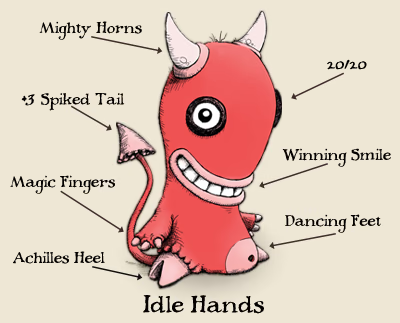
I certainly didn't plan any of this in 2008.
I thought I was making a vinyl figure.
Apparently the little monster had other ideas.
Idle Hands started as something I made. Eventually, it became the thing I make things under.